
The Great Flattening: Navigating the Age of Job Compression
- Mar 9
- 5 min read
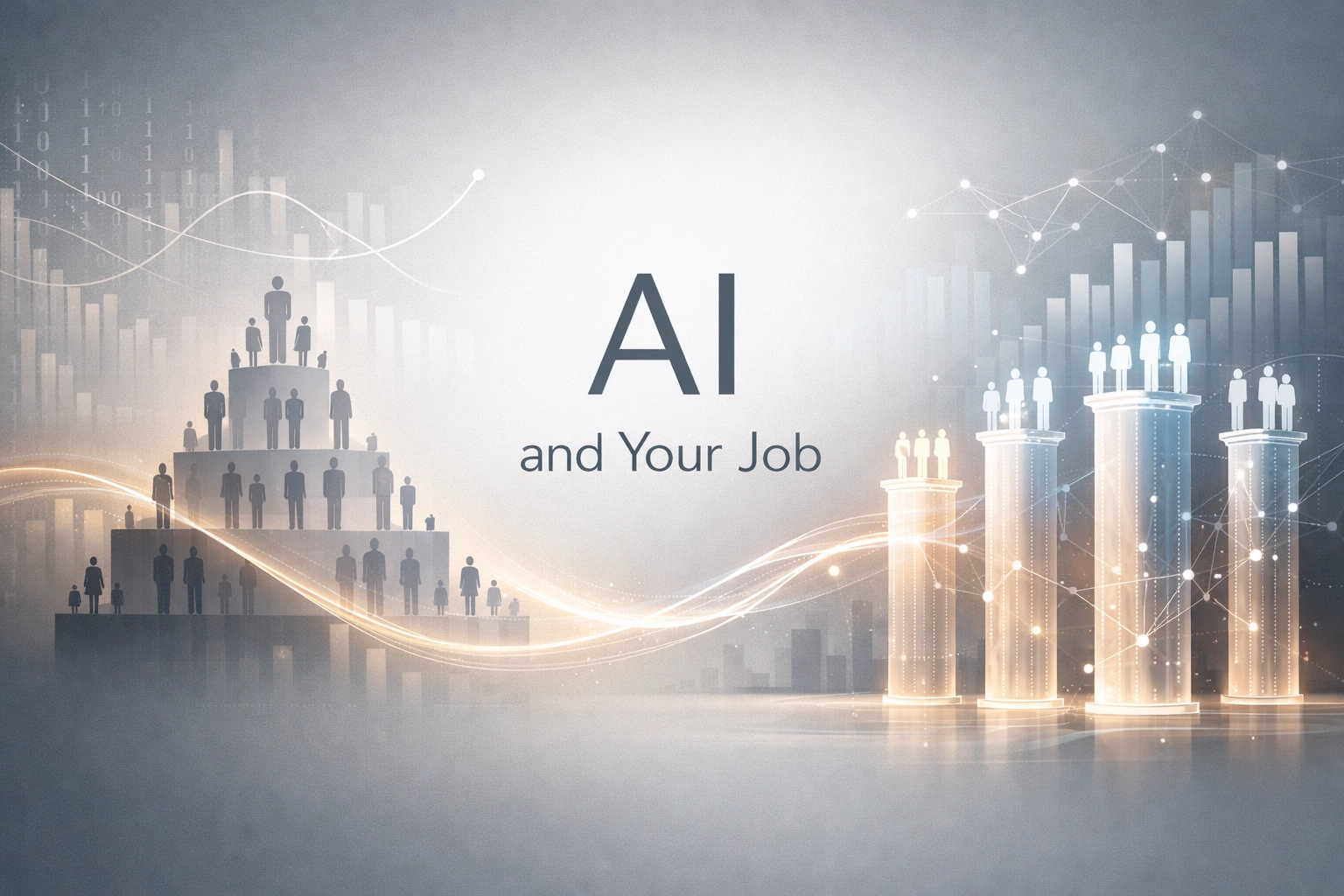
If you feel like the ground is shifting beneath your feet, it isn’t your imagination. It is a rational response to the data. What you’re sensing has a name: job compression. Work is not disappearing evenly. It is being compressed upward into fewer roles with broader scope and higher leverage.
As we stand here in March 2026, the "Great Convergence" is no longer a theoretical framework discussed in ivory towers. It is our daily reality. Specifically, we are seeing the collision of Force 1 (Exponential AI) and Force 2 (Economic Volatility). Together, they’re flattening org charts and tightening the funnel into the middle class.
At MyConvergenceAssistant.com, we track these shifts daily. Right now, that metric is flashing red. In a high-volatility environment, organizations stop paying for “extra coordination” and start paying for outcomes. That single change is what triggers the Great Flattening.
The Great Flattening: Job Compression Is the New Default
Job compression occurs when output increases but headcount remains unchanged. AI doesn’t just automate tasks; it collapses layers of coordination that used to require people, meetings, approvals, and handoffs.
Stanford’s Digital Economy Lab data makes this concrete: employment for entry-level workers (ages 22–25) in AI-exposed roles is down 16%. That is not a headline. It is a structural signal. The traditional “first rung” is narrowing, and the path that used to turn juniors into seniors is being redesigned in real time.
This is why you feel the floor move. The ladder is still there, but fewer people are allowed to step onto it.

The Great Flattening: Job Compression Is the New Default
Job compression occurs when output increases, and headcount shrinks. AI doesn’t just automate tasks; it changes roles that used to require people, meetings, approvals, and handoffs.
Stanford’s Digital Economy Lab data makes this concrete: employment for entry-level workers (ages 22–25) in AI-exposed roles is down 16%. That is not a headline. It is a structural signal. The traditional “first rung” is narrowing, and the path that used to turn juniors into seniors is being redesigned in real time.
This is why you feel the floor move. The ladder is still there, but fewer people are allowed to step onto it.
AI as Coordination-Compressing Capital
Most people talk about AI like it’s software. Leaders are deploying it like it’s capital.
Here’s the mental picture you need: AI is coordination-compressing capital. It’s “capital” because you invest once (tools, data, workflows) and it keeps producing. It’s “coordination-compressing” because it eliminates the need for layers of manual work, such as status checks, basic analysis, first drafts, routing, and follow-ups.
This is producing a structural Fork in the workforce—a way to assess your position and next steps.
• General productivity: Many people get modest gains, wages stabilize, and organizations reinvest the surplus broadly.
• New productivity: This is organizations and managers that capture outsized gains because AI scales their decisions and outputs without scaling their payroll or time.
You do not get to sit this fork out. You are already on one side of it—the question is just which one.
The Internal Coordination Squeeze: Middle Management Gets Rewritten
There’s a second compression happening inside companies: the internal coordination squeeze.
For decades, middle management served as a buffer—translating strategy into work, coordinating across teams, and catching errors before they hit customers. AI now performs a growing share of that translation and coordination.
This is the moment managers either get flattened or level up.
Many managers are being recast as Orchestrators of AI agents:
• They define the objective and constraints.
• They set quality thresholds and review loops.
• They allocate agent workflows across functions.
• They own the business outcome, not the task list.
The teams that win aren’t the ones with the most people. They’re the ones with the cleanest goals, the best agent workflows, and the fastest feedback loops.
And that brings this back to you: if your value is “doing,” AI can compress you. If your value is “orchestrating,” AI can multiply you.
From Pyramids to Columns: Pulling Up the Ladder
For a century, the corporate structure has been a Pyramid. A wide base of junior employees supported a smaller middle-management layer, which supported the executives at the top. This structure served two purposes: it got the "grunt work" done, and it served as a training ground for future leaders.
AI has turned the Pyramid into a Column.
The wide base of "Doers" is being replaced by AI agents. What remains are "Orchestrators": skilled seniors and executives who manage the AI output. These columns are incredibly efficient and profitable, but they are nearly impossible to enter from the bottom.
If you are currently in a role where your primary value is "doing": writing code, drafting emails, analyzing data, or coordinating schedules, you are standing in the path of the tsunami. The ladder is being pulled up. If you aren't already on the platform, you need to find a new way to climb.
[Image: A single futuristic pillar rising above crumbling stone pyramids, illustrating the new AI business model.]
The Only Path Forward: From Doer to Orchestrator
Strategic Resilience in 2026 is not about working harder. It is about shifting your identity and your output. To remain indispensable, you must move from being a "Doer" to being an Orchestrator.
An Orchestrator is someone who understands the high-level business objective and knows how to direct a fleet of AI tools to achieve it. They don't write the code; they define the architecture and audit the AI’s work. They don't write the marketing copy; they define the strategy and oversee the AI-generated campaigns.
The goal is to maximize AI output while maintaining human judgment as the final filter. This is the only way to stay ahead of the flattening and columnizing.
At MyConvergenceAssistant, we see this transition happening in real-time. Our members use the personal Risk Assessment in the portal to identify where they’re exposed—and where they’re already stronger than they realize. Then the Action Planner helps you address the weak points found in your Personal Risk Assessment with practical next steps you can execute, not vague motivation.
We provide the curated signals; you build the resilience. And if you want deeper, research-grade analysis, our Premium Analyst tier (coming in 2026) will add advanced research, charts, and academic reviews.
The Global Arms Race: US vs. China and the Regulatory Lag
This isn’t just an innovation cycle. It’s a geopolitical intelligence race. The US and China are locked in a struggle for AI dominance, and neither side can afford to slow down. That reality removes the fantasy that “the pace will cool off” once the headlines pass.
While Europe focuses on regulation, the US and China are focusing on deployment. This creates a regional divergence where some economies will thrive on AI-driven exports and productivity, while others will struggle under the weight of outdated labor laws and regulatory friction.
For you as an individual, this means you cannot wait for the government to “fix” job compression. Policy moves more slowly than capital, and agent capital is being deployed now.

Conclusion: Assess Your Position on the Fork
The Great Flattening is not a mood. And it's not going away.
The steps are clear:
Name the Shift: Job compression is the new default. Treat it as data, not drama.
Assess Your Position: Understand whether your role is trending toward general productivity or superstar concentration.
Become an Orchestrator: Build the skill of directing AI agents toward business outcomes, with your judgment as the quality gate.
In a world that's volatile, clarity is a competitive advantage.
If you want to stop guessing and start moving with precision, start with the tools that are live right now: the Personal Risk Assessment, the Action Planner, and the Community—so you’re not navigating job compression alone.
We provide the curated signals; you build the resilience. Act before your org chart flattens without you.
Comments